A cavity is a 31-minute problem. We treat it like one.
A filling is dentistry's most routine repair: the decayed part of the tooth comes out, and a composite resin matched to your exact tooth shade goes in — bonded in place, light-cured hard in seconds, and shaped until your bite feels like nothing happened. No metal, no gray glint when you laugh. Just the tooth, working again.
Most cavities announce themselves quietly — a checkup finding, a twinge with something cold, a floss thread that keeps catching. The old dental model answers that with a diagnosis today and a drill appointment three weeks out, which is exactly how small cavities get time to become big ones. We run differently: doors open 7am to 7pm, seven days, walk-ins first-class. The gap between finding a cavity and fixing it should be measured in days, not calendar pages.
Inside the visit, only one window truly requires the dentist: removing the decay and placing the core of the filling. Everything around it — numbing, isolation, curing, polishing, bite checks — is choreographed to the team, which is how a single filling fits our 31-minute average. One honest caveat: if you need several fillings on opposite sides of your mouth, we may suggest splitting them into two short walk-in visits rather than one long haul. Two easy half-hours beat one numb afternoon.
And you will know the price before you're numb. A one-surface white filling runs $175 on a front tooth and $195 on a back tooth; two surfaces $245, three $295 — all on the published founding fee schedule, with members paying $140–$236. The quote is confirmed in writing before we start. Every time.
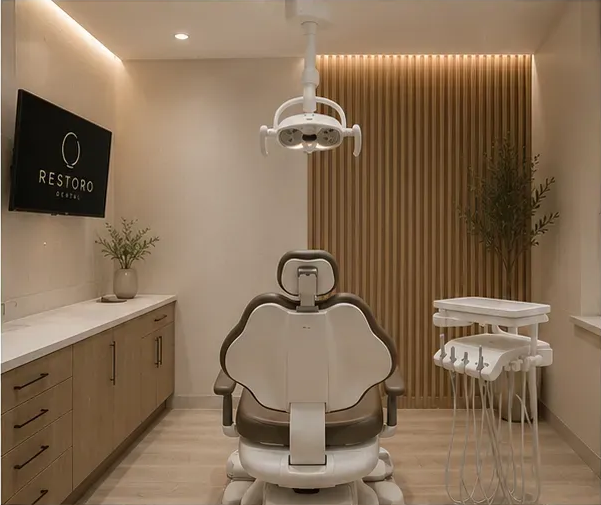
The 31-minute choreography
-
Kiosk check-in
Two taps at the iPad kiosk — the system already knows which tooth from your exam record and routes you straight to an open room. No waiting-room purgatory.
-
Numbing with a head start
Topical gel first, then local anesthetic. While it takes hold, your assistant sets up isolation and shade-matches the composite. We do not start until you are fully numb — you set that pace, not the clock.
-
The dentist window
This is the part only a dentist can do: decay out, margins clean, tooth prepared. Focused minutes, no interruptions — the queue system protects this window.
-
Layer, cure, repeat
Composite goes in thin layers, each one hardened with a curing light in seconds. Layering is what makes the filling strong and the shade invisible.
-
Bite check and polish
You tap on marking paper, we adjust until the bite reads even, then polish to a natural gloss. A high spot fixed now is a sore tooth prevented later.
-
Out the door
Composite is fully hard the moment it's cured — you can eat as soon as the numbness fades. Aftercare arrives in one text. Done.
Fees
| White filling — front tooth, one surface | $175 | $140 member |
|---|---|---|
| White filling — back tooth, one surface | $195 | $156 member |
| White filling — back tooth, two surfaces | $245 | $196 member |
| White filling — back tooth, three surfaces | $295 | $236 member |
This is our founding fee schedule — real prices, published before we open. Every fee is per procedure and confirmed in writing before treatment starts. No surprise billing, ever. Member prices apply with any Restoro membership plan. Final schedule locks at opening.
Questions, answered plainly
Does getting a filling hurt?
The honest answer: you'll feel the anesthetic pinch for a second or two, and possibly some pressure during the work — but not pain. We use topical gel before the injection and we never start until you confirm you're numb. Some teeth feel mildly sensitive for a few days afterward; if it lasts longer, walk back in and we'll check the bite at no charge.
How long will a white filling last?
It depends on the filling's size, where it sits, and how the tooth is used — so we won't quote you a magic number. What we can promise is surveillance: on the ~90-day membership rhythm, your fillings get looked at several times a year, and a worn margin gets caught while the fix is still small.
What if I need more than one filling?
Cavities in the same area usually get done in one visit — same anesthetic, same window. Fillings on opposite sides of your mouth are often better split into two short walk-in visits so you're never fully numb on both sides. Either way, the full plan and total price are put in writing before anything starts.
When is a filling not enough?
When decay has taken too much of the tooth, a filling can't carry the biting load — that's crown territory, and if decay reaches the nerve, root canal territory. We'll tell you straight, and because our whole fee schedule is public ($1,250 for a ceramic crown, $850–$1,150 for a root canal), you can check that the recommendation isn't a sales pitch.
Do you replace old silver (amalgam) fillings?
Yes — when they're cracked, leaking, or you simply want the metal gone. But we don't campaign against sound amalgam: an old silver filling that's still sealed and solid can stay right where it is. We photograph what we see and let you decide with the evidence in front of you.
What does a filling cost — really?
The numbers are published: $175 for a one-surface front tooth, $195–$295 for back teeth depending on surfaces. Members pay $140–$236 — the membership discount runs 15–25% across the fee schedule. No consult-then-quote theater; the founding fee schedule is on this site now, before we've even opened.
Come in when it works for you.
We open September 2026 in the Ponte Vedra–Nocatee corridor. Founding members lock $29/month for life — cleanings, exams, X-rays, and a whitening touch-up with every visit.